A Victorian wall box in Ballyoughter, c. 1881–1901
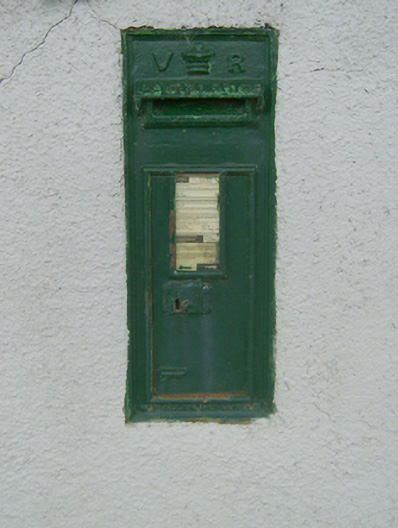
Set into the wall of an outbuilding within the grounds of the former Ballyoughter Parochial House is a surviving Victorian post box dating from the late nineteenth century. The National Inventory of Architectural Heritage dates the box to 1881–1901 and records it as a structure of regional artistic, historical and social significance.
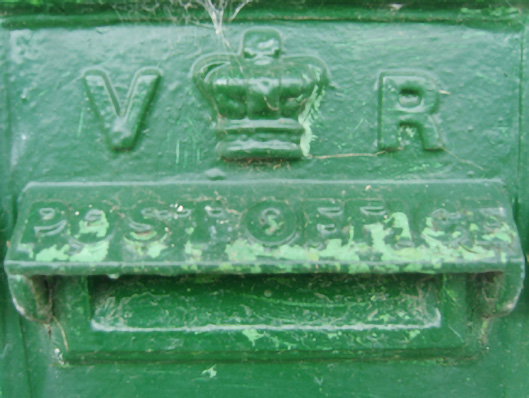
Cast in iron and supplied by W.T. Allen & Company of London, the box bears the royal cypher VR — Victoria Regina — identifying it with the reign of Queen Victoria. Originally part of the British postal system in Ireland, it survived the political changes of the early twentieth century and, like many pre-independence post boxes, was subsequently painted green while retaining its Victorian royal insignia.
A Victorian Wall Box
The Ballyoughter post box is a wall-mounted cast-iron “wall box”, a type developed as a less expensive alternative to the larger freestanding pillar box.
The National Inventory of Architectural Heritage dates the Ballyoughter post box to 1881–1901. It was supplied by W.T. Allen & Company of London, a firm that manufactured cast-iron post boxes for the postal service during the late nineteenth and early twentieth centuries.
The front of the box carries the royal cypher VR, meaning Victoria Regina — Queen Victoria — together with a crown. Queen Victoria reigned from 1837 until 1901, and the cypher identifies the post box with the Victorian period.
The Ballyoughter box is an interesting surviving example of the mass-produced cast-iron street furniture that accompanied the expansion of the nineteenth-century postal service. Although primarily practical objects, Victorian post boxes were also carefully designed, with cast lettering, royal insignia and other details giving them a distinctive appearance.
The National Inventory of Architectural Heritage records the Ballyoughter post box as Registration No. 15701129 and rates it as being of Regional importance, with artistic, historical and social significance. The inventory also records the structure as a post box in both its original and present use.
National Inventory of Architectural Heritage
Registration number: 15701129
Date: 1881–1901
Original use: Post box
Current use: Post box
Rating: Regional
Special interest: Artistic, Historical, Social
Supplier: W.T. Allen & Company, London
The Postal Service in Ireland
The nineteenth century transformed the way letters were sent and received. In 1840, the introduction of the Uniform Penny Post greatly reduced and simplified postal charges, while the Penny Black, the world’s first adhesive postage stamp, allowed postage to be prepaid by the sender.
These reforms made sending letters more affordable and contributed to a rapid expansion of the postal service. Growing railway and steamship networks also allowed mail to travel more quickly between towns, cities and rural communities.
Ireland received its first roadside pillar boxes in 1855. The novelist Anthony Trollope, who worked for the Post Office in Ireland for many years, played an important role in the development and introduction of roadside letter boxes.
As the postal network expanded, several different types of post box appeared. Large freestanding pillar boxes became familiar features of towns and cities, while smaller wall boxes provided a more economical alternative. They could be manufactured in different sizes and fitted directly into existing walls, making them particularly suitable for smaller communities and rural locations.
Mail deposited in boxes such as the one at Ballyoughter could therefore enter an increasingly extensive postal network connecting even relatively small rural communities with the rest of Ireland and places much further afield.
Sources: An Post, Anthony Trollope Gets Stamp of Approval and About Postboxes; Mary Davies and Damian Murphy, “Victorian Post Boxes,” History Ireland, Vol. 16, No. 3, May/June 2008.
From Red to Green
The Ballyoughter post box was installed when Ireland formed part of the United Kingdom and the postal service operated as part of the British system. Like other Victorian post boxes in Ireland, it would originally have been painted red and displayed the royal insignia of the reigning monarch.
The establishment of the Irish Free State in 1922 left the new state with an extensive postal infrastructure inherited from the previous administration. An extensive network of existing post boxes already stood in towns, villages and rural communities throughout the country.
Rather than replacing this valuable network, the existing boxes were retained and gradually repainted green. The change of colour gave the postal system a recognisably Irish appearance while allowing the existing infrastructure to remain in service.
The original royal cyphers were generally left in place. Surviving pre-independence post boxes can therefore still display the initials of the monarch during whose reign they were manufactured. These include VR for Victoria Regina, ER VII for Edwardus Rex VII and GR for Georgius Rex.
The Ballyoughter post box therefore preserves two distinct layers of Irish history. Its cast-iron VR cypher and crown record its Victorian origins, while its green paint reflects its continued use following Irish independence.
Post boxes manufactured for the Irish state increasingly carried Irish markings instead of British royal cyphers. Examples include S.E. representing Saorstát Éireann, and later P&T, representing the Department of Posts and Telegraphs.
The survival of boxes such as the one at Ballyoughter provides a particularly visible reminder of political change: the colour and administration changed, but the durable Victorian cast-iron structure remained.
Sources: Cork Public Museum, Post Boxes; Stephen Ferguson, The Irish Post Box: Silent Servant and Symbol of the State (2009).
Ballyoughter Post Box Today
The Victorian wall box remains in place at Ballyoughter and continues to provide a visible link with the development of the postal service during the late nineteenth century.
Its survival is particularly significant because important features of its original design remain clearly visible. These include its wall-mounted cast-iron construction, the crown and the prominent VR royal cypher, identifying the box with the reign of Queen Victoria.
The photographs below record the post box at different times and show both its setting and its surviving Victorian details.
Photographs: Shane Eivers

Sources and Further Reading
- National Inventory of Architectural Heritage. “Balloughter, Co. Wexford.” Registration No. 15701129.
- An Post. Anthony Trollope Gets Stamp of Approval.
- An Post. About Postboxes.
- Davies, Mary, and Damian Murphy. “Victorian Post Boxes.” History Ireland, Vol. 16, No. 3, May/June 2008.
- Cork Public Museum. Post Boxes.
- Ferguson, Stephen. The Irish Post Box: Silent Servant and Symbol of the State. Dublin: An Post and Associated Editions, 2009.