The Church is a handsome stone building of Gothic design with a small campanile surmounting the entrance gable. The architect was George Ashlin, pupil and son-in-law of Agustus Welby Pugin. The ‘Irish Builder’ for 15th June 1874 gave a detailed description of the new church:
The internal dimensions are 70 feet by 30 feet, chancel, 20 feet by sixteen feet. The roof is open sheeted, with arched principals. The walling is of local brownestone, with dressings of a white sandstone obtained from a quarry in the neighbourhood.
Ballyoughter Church of the Sacred Heart – The Irish Builder No. 348 – June 15th 1874 – This image is in the Public Domain
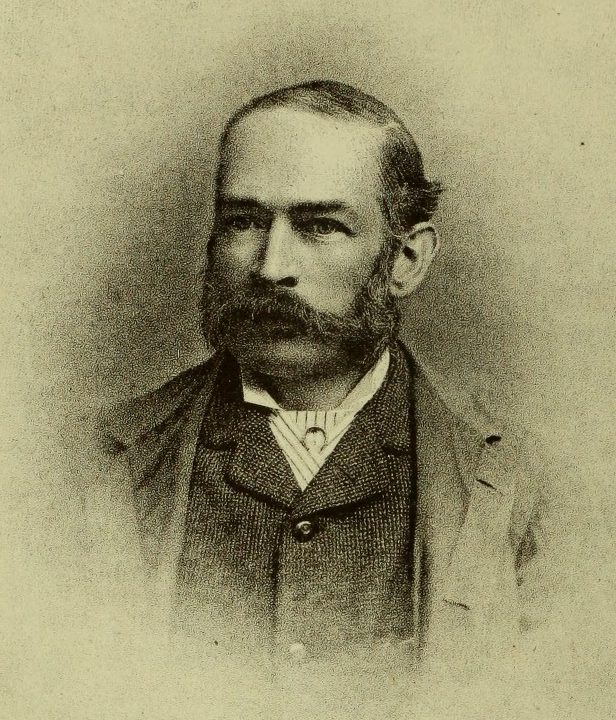
George Coppinger Ashlin – This image is in the Public Domain
George Coppinger Ashlin was born in Ireland on 28th May 1837 at Little Island, County Cork. He was educated at the College de St Servais, Liege. He then attended St Mary’s College, Oscott, from 1851 to 1855, where he studied drawing and perspective. This led to an interest in Architecture, and he became a pupil of Augustus Welby Northmore Pugin from 1856 to 1860, entering the Royal Academy Schools in London in 1858.
Pugin is best remembered for his part in the revival of Gothic architecture in England and was responsible for designing the interior of Westminster Palace and the ‘Big Ben’ clock tower.
Ashlin became a partner to Pugin in 1860 and he took responsibility for work in Ireland, setting up the ‘Pugin and Ashlin’ office at St. Stephen’s Green, Dublin. Their first commissioned work was Saints Peter and Paul Cathedral in Cork. Ashlin was responsible for the building of up to 50 churches in Ireland, including the Church of the Sacred Heart in Ballyoughter.
Ashlin married Pugin’s daughter, Mary, in 1867 with whom he had one daughter. He split from Pugin in 1870 but continued to work on his own as an Architect while living in Dublin. He served as President of the Royal Institute of the Architects of Ireland from 1902 to 1904. George Ashlin died on the 10th of December 1921, aged 84, and is buried in Glasnevin.