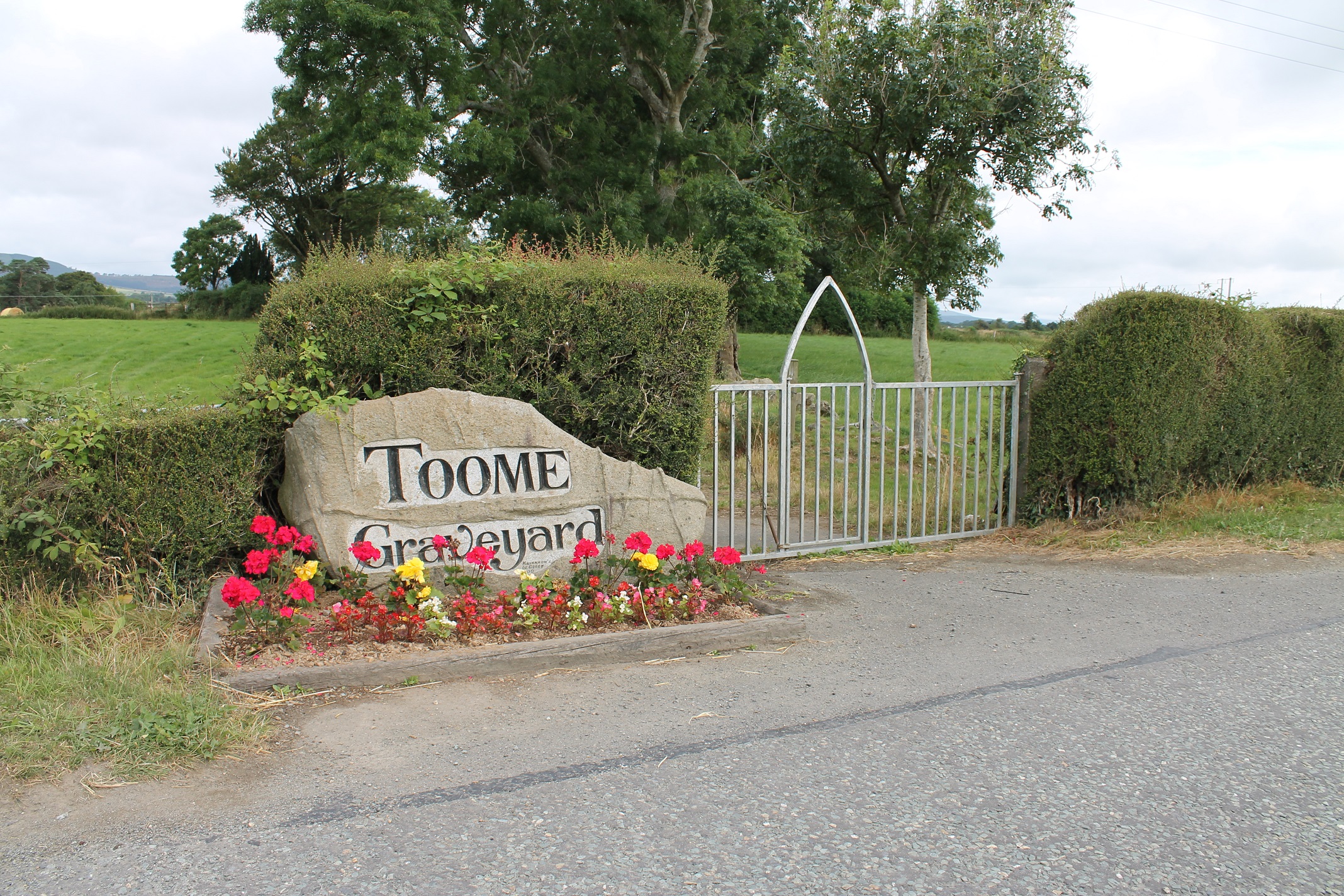
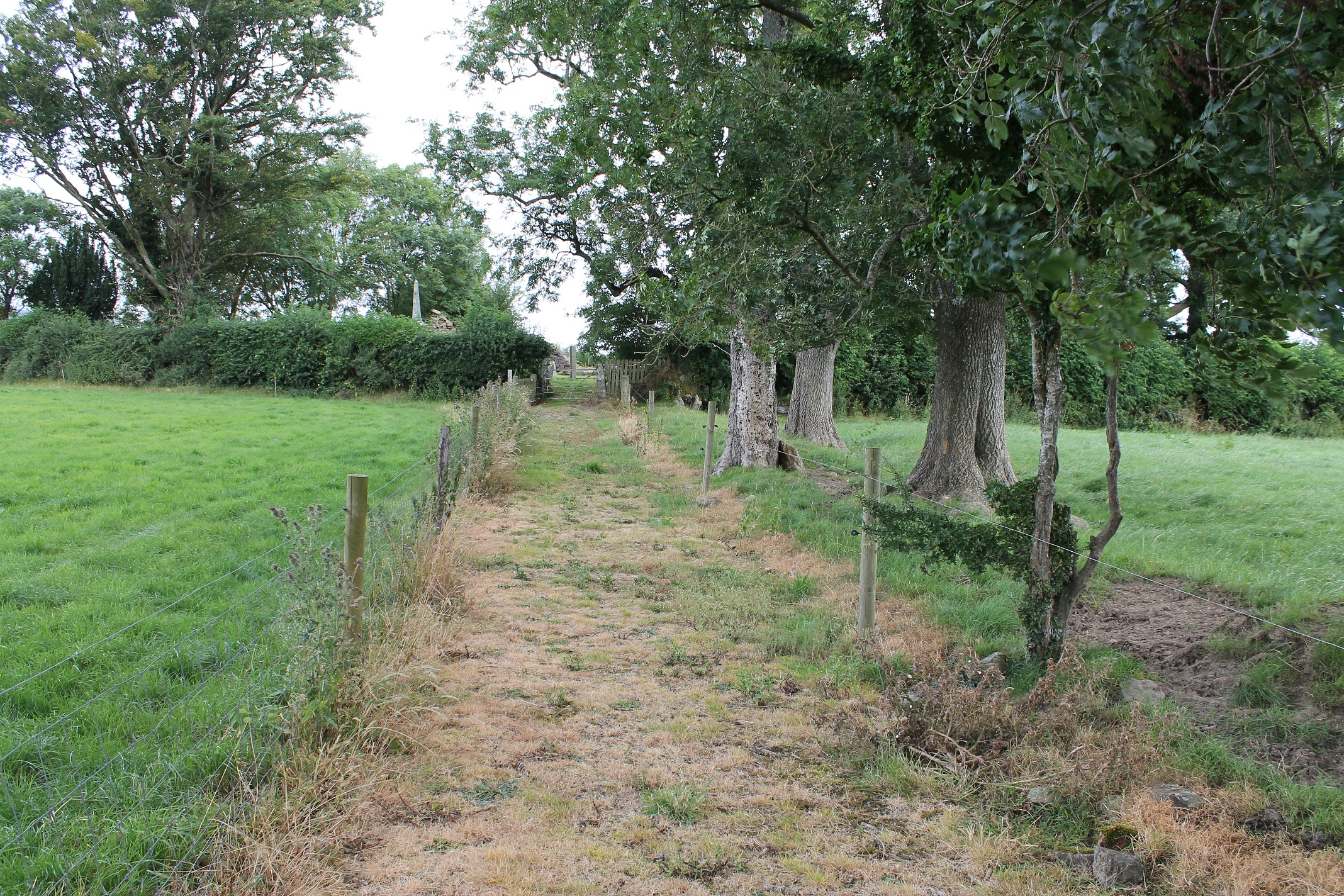
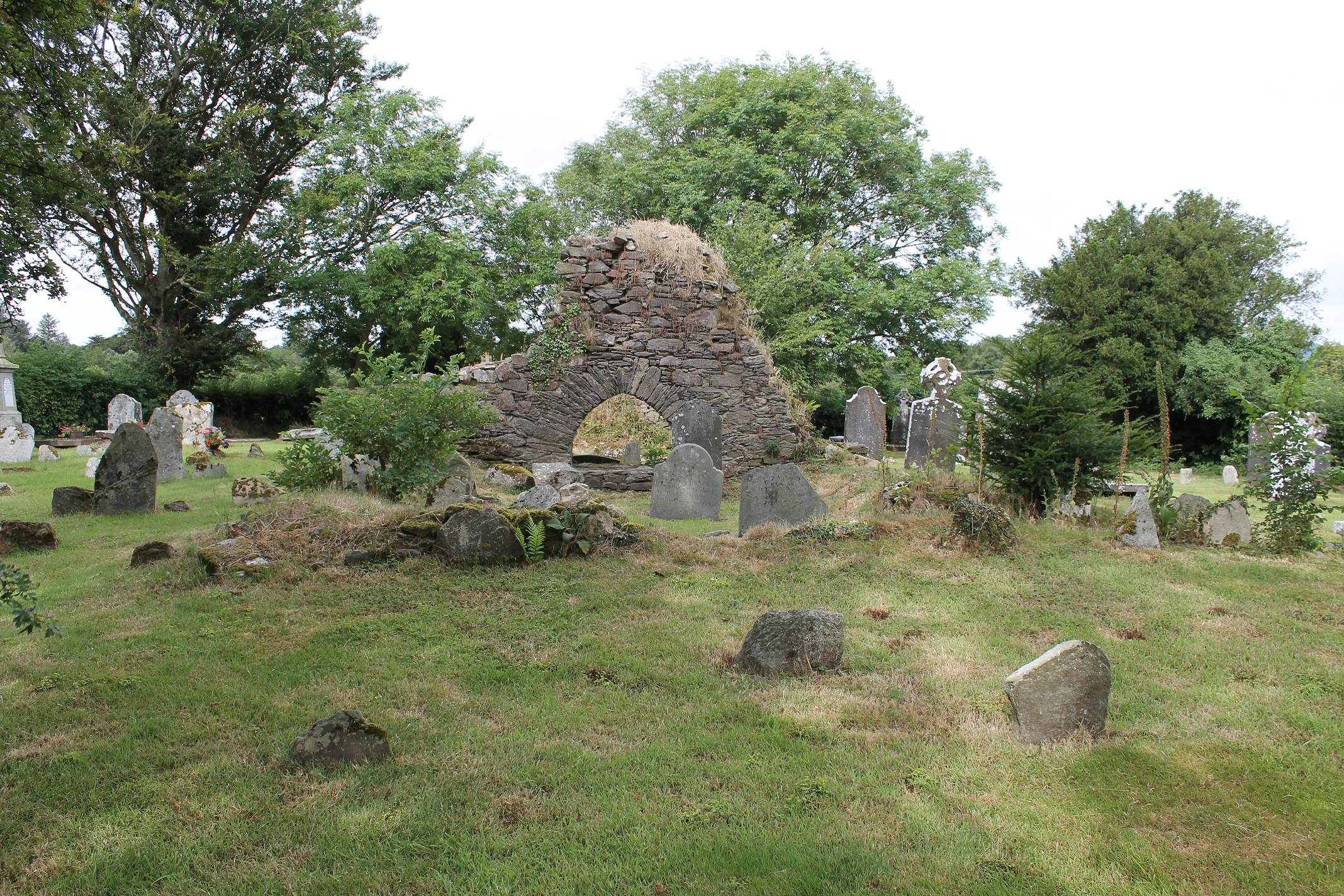
Toome Church and Cemetery, in the townland of Ballinclare between Clough and Camolin, is one of the most atmospheric historic sites connected with Ballyoughter. The ruined parish church dates to the early seventeenth century and stands within a graveyard that is still used for burials today. The site is also notable for its bullaun stone, early gravestones and possible links to a much older ecclesiastical settlement.
The Parish of Toome has been recorded under several earlier forms, including Tombe, Tomb, Tome and Tuaim. The parish is unusual in that it is partly in the Barony of Gorey (Gory) but mainly in the Barony of Scarawalsh (Scarawalch). Its division between the two baronies can be viewed on Trinity College Dublin’s interactive Down Survey maps.
The name Toome most likely comes from the Irish Tuaim, meaning a mound or tumulus. This connection was noted by the scholar John O’Donovan around 1840 and hints at the deep layers of history associated with the site. A tumulus is a mound of earth and stones raised over a grave or graves.
The church itself was recorded in 1615 during a formal visitation carried out by Thomas Ram, the Protestant Bishop of Ferns. At that time, the church was functioning in its post-Reformation form, with John Alcock serving as priest and John Lacy as curate. Both the nave and chancel were described as being in good repair. Today, the remains are much less complete. Three walls of the nave survive close to roof height, while the chancel has collapsed and is now visible mainly as a sunken depression in the ground.
Outside the church is a bullaun stone. Bullauns are stones or slabs with one or more deliberately carved basins and are commonly associated with early Christian sites in Ireland. The example at Toome is modest in size, measuring roughly 73 centimetres long, but it has an unusual additional feature: an indented rectangular line etched into the upper surface beside the basin. Its original purpose is now unknown. In local folklore, bullaun stones were sometimes known as curing stones or cursing stones, and the water collected in them was believed to have healing properties.
The wider setting suggests that Toome was once a more significant ecclesiastical site than the visible ruins alone might suggest. The church and graveyard sit within a subrectangular earthen enclosure, while aerial imagery has revealed two larger oval enclosures beyond it. These cropmarks, visible only from above, may represent filled-in ditches or fosses associated with an early ecclesiastical complex. Nearby cropmarks also show the outline of a rath, suggesting that centuries of settlement, worship and burial have overlapped on this low Wexford ridge.
North Wexford Historical Society has recorded a large number of headstones in Toome Cemetery. These records are a valuable resource for anyone researching local families, burial places or the history of the wider Toome and Ballyoughter area.
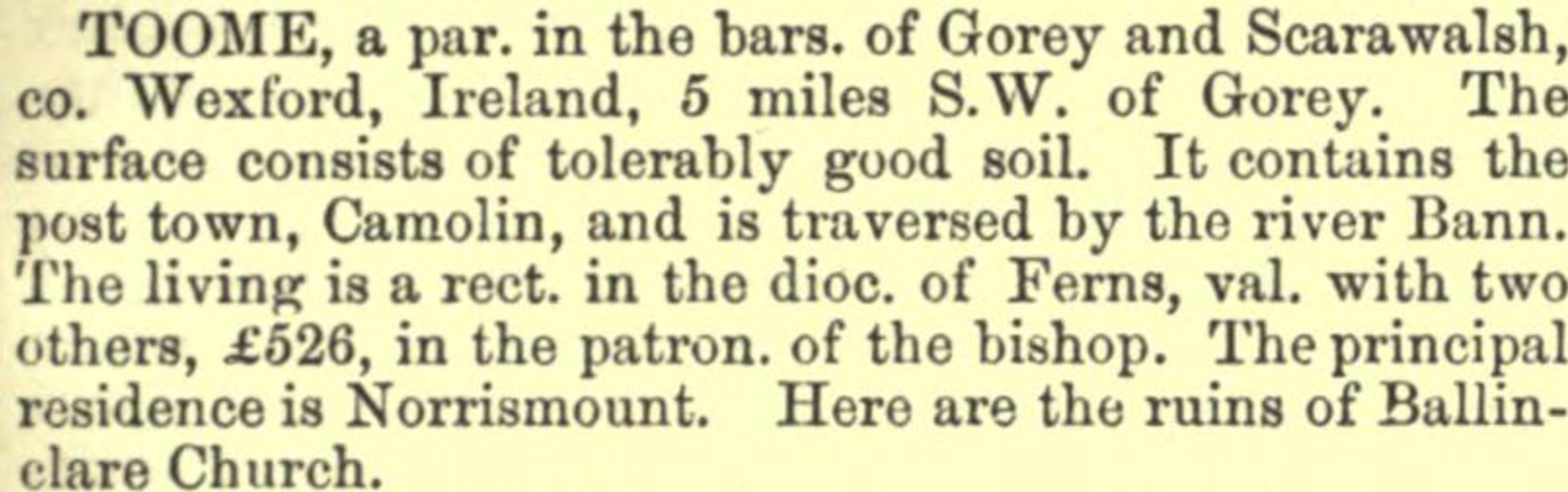
Description of Toome Parish in ‘The National Gazetteer of Great Britain and Ireland 1868’ – Page 674 – Internet Archive – Uploaded by University of Toronto Kelly Library – This image is in the Public Domain.
Directions to Toome Church and Cemetery
Toome Church and Cemetery is located in the townland of Ballinclare, between Clough and Camolin, approximately 7 km south-west of Gorey.