Dean Swift, Gorey and the Iron Well at Tubberneering
Jonathan Swift’s association with Gorey and the Iron Well at Tubberneering is one of the most colourful stories preserved in local tradition. The story is part of local folklore, but it also has a documented historical core and was recorded in written accounts long after the events themselves.
In 1728, Swift and his friend Thomas Sheridan became involved in an incident connected with Abel Ram, a prominent Gorey landowner. The encounter subsequently became the subject of satire and, over time, developed into the familiar story of the “Ram of Gorey”. Local tradition also records that Swift was travelling to Tubberneering to take the iron-rich waters of the spa, while later folklore preserved both a rhyme concerning his encounter with Ram and a humorous story about a dinner of rabbit.
These stories were still being told more than two centuries later when versions of them were recorded in the Schools’ Collection in the late 1930s.
Jonathan Swift: Writer, Dean and Patriot
Jonathan Swift (1667–1745) is probably best known as the Anglo-Irish author of Gulliver’s Travels, one of the world’s great satirical fantasies. He was also a highly regarded political satirist and poet whose writing frequently challenged the political and social conditions of his time.
Swift was educated at Kilkenny College and later at Trinity College Dublin. He subsequently entered the Church and served as Dean of St Patrick’s Cathedral, Dublin, from 1713 until his death in 1745, earning him the familiar name “Dean Swift”.
Swift often wrote critically about what he regarded as the terrible living conditions, poverty and political and economic injustices experienced in Ireland. His campaigns on Irish issues, particularly his opposition to the introduction of William Wood’s copper coinage through his Drapier’s Letters, helped establish his reputation as the “Hibernian Patriot.”
Swift’s Illness
From his early twenties, Swift suffered from a debilitating recurring illness characterised by vertigo, dizziness, giddiness and ringing in the ears, or tinnitus. Problems with his hearing also became increasingly troublesome during his life.
His symptoms have often been retrospectively interpreted as being consistent with Ménière’s disease, a disorder of the inner ear affecting hearing and balance. The condition can cause attacks of vertigo, tinnitus and hearing loss and, although its symptoms can be managed, there is still no cure.
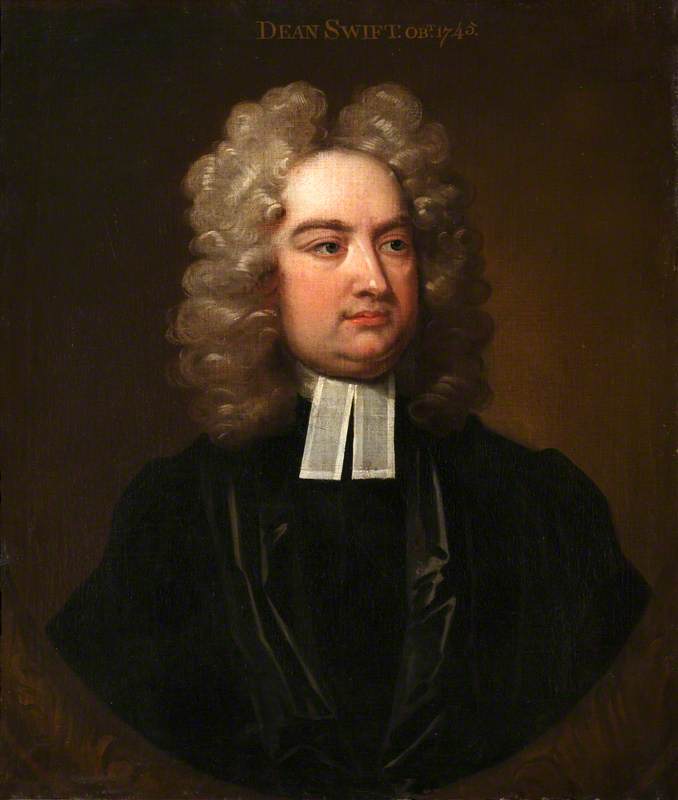
Collection: Knole, The Sackville Collection, National Trust. Image source: Wikimedia Commons. Rights: Public domain.
Swift, Gorey and the Iron Well
Jonathan Swift was a friend of the Ram family of Gorey. Local tradition records that in 1728 he travelled to the Gorey area and intended to visit the spa at Tubberneering, where the iron-rich waters of the chalybeate well were taken for what were then believed to be their medicinal and restorative properties.
The connection between Swift and the spa was still remembered locally in the late 1930s. An account collected at the Christian Brothers’ School in Gorey records that Swift was a friend of the Rams and that, on one occasion, he was travelling to Tubberneering to avail himself of the spa when his carriage came into collision with that of Mr Ram.
Another version of the story, recorded in the Schools’ Collection at Reary, Rosenallis, Co. Laois, remembers Swift as being on a visit to Gorey and walking along the road when he was knocked into a ditch by a carriage belonging to a local landlord nicknamed the “Ram of Gorey.”
The differences between the surviving accounts are typical of stories transmitted orally over many generations. However, the association between Swift, Sheridan and Abel Ram also has a stronger documentary basis than folklore alone.
The Ram of Gorey
The man remembered as the Ram of Gorey was Abel Ram, a member of the influential Ram family associated with Gorey and Ramsfort.
Swift’s travelling companion and friend Thomas Sheridan later satirised Ram under the name “Squire Wether”. Sheridan and Swift were at the time producing a periodical called The Intelligencer, and its second number, published in 1728, was entitled The Inhospitable Temper of ’Squire Wether.
The incident described there concerns the dangerous and discourteous behaviour associated with the carriage of a country squire. Later biographical accounts identified the squire as Abel Ram of Gorey, and the episode subsequently entered local folklore.
According to the version traditionally told in the Gorey area, Swift was knocked into the ditch by the coachman of Abel Ram. On rising to his feet, he is said to have responded with the lines:
England’s hope and Ireland’s glory
Was tipped in the ditch by the Ram of Gorey.
The wording of the rhyme varies between surviving accounts. The Gorey Schools’ Collection, for example, preserves a version referring to “England’s dread and Ireland’s glory”, while another account collected in County Laois remembers Swift identifying himself as “England’s pride and Ireland’s glory.” The variations demonstrate how the incident continued to develop as it was passed from one generation to another.
Rabbit for Dinner
Local tradition preserves another story concerning Swift and Abel Ram.
According to the tale, Ram later invited Swift to dinner and decided to make fun at his guest’s expense by arranging for rabbit, and rabbit alone, to be served throughout the meal.
Swift refused to take the bait. He ate his dinner without complaint and behaved as though there was nothing unusual about the meal. Only when he was asked to say grace afterwards did he respond.
According to the traditional version preserved locally, Swift recited:
We had rabbits young and rabbits old,
We had rabbits hot and rabbits cold,
We had rabbits tender and rabbits tough,
We thank Thee, Lord, we had rabbits enough.
The rabbit-dinner story was also preserved in the Gorey Schools’ Collection, demonstrating that both parts of the Ram story—the roadside encounter and the dinner that followed—remained part of local memory more than two centuries later.
Swift in the Schools’ Collection
Two particularly interesting versions of the story survive in the Schools’ Collection.
The Gorey Account
The most locally significant account comes from the Christian Brothers’ School, Gorey.
The account forms part of a history of the Parish of Gorey and records that the Ram family became wealthy and powerful at Ramsfort, previously known as Ballyowen. It then states that Dean Swift was a friend of the Rams.
According to this version, Swift was travelling to Tubberneering to avail himself of the spa when his carriage collided with that of Mr Ram. Swift and his driver were thrown into the ditch, after which the familiar rhyme concerning the Ram of Gorey was supposedly spoken.
The account continues with the invitation to dinner and the attempt to play a joke on Swift by serving rabbit alone.
The material is preserved in The Schools’ Collection, Volume 0891, Pages 003–008, with the Swift story appearing within the account of the Parish of Gorey.
Source: The Schools’ Collection, Volume 0891, pp. 003–008, Guaire Christian Brothers’ School, Gorey, Co. Wexford. Dúchas © National Folklore Collection, UCD. Licensed under CC BY-NC 4.0.
The Reary Account
A second version was recorded at Reary School, Rosenallis, Co. Laois, demonstrating that the Ram of Gorey story had spread considerably beyond north County Wexford.
Entitled “Dean Swift and the Ram of Gorey”, this account remembers Swift as being on a visit to Gorey when, at a sharp bend in the road, he was knocked into a ditch by a carriage belonging to a local landlord nicknamed the Ram of Gorey.
The story is written by Margaret Conroy of Meelick, Co. Laois, with Patrick Conroy recorded by Dúchas as the informant.
Source: “Dean Swift and the Ram of Gorey”, The Schools’ Collection, Volume 0823, p. 158, Reary, Rosenallis, Co. Laois. Dúchas © National Folklore Collection, UCD. Licensed under CC BY-NC 4.0.
Taken together, the two accounts demonstrate how the encounter between Swift and the Ram of Gorey survived in popular memory, while the differences between their wording also show how oral traditions can change as they are retold over time.
Swift’s Legacy in Dublin
Jonathan Swift died in 1745 and was buried in St Patrick’s Cathedral, Dublin, where he had served as Dean for more than three decades. His grave and memorial remain closely associated with his long connection with the Cathedral.
A bust of Swift can also be found in St Patrick’s Cathedral. The marble bust was created by sculptor Patrick Cunningham for the Dublin publisher and bookseller George Faulkner and was later presented to the Cathedral.
Swift is also commemorated at Trinity College Dublin, where a marble bust by the French sculptor Louis-François Roubiliac is displayed in the Long Room of the Old Library. The bust was placed there in 1749, only a few years after Swift’s death.
The Cathedral also contains a memorial to Hester Johnson, known as “Stella”, whose close relationship and correspondence with Swift formed an important part of his personal and literary life.
Jonathan Swift at St Patrick’s Cathedral and Trinity College
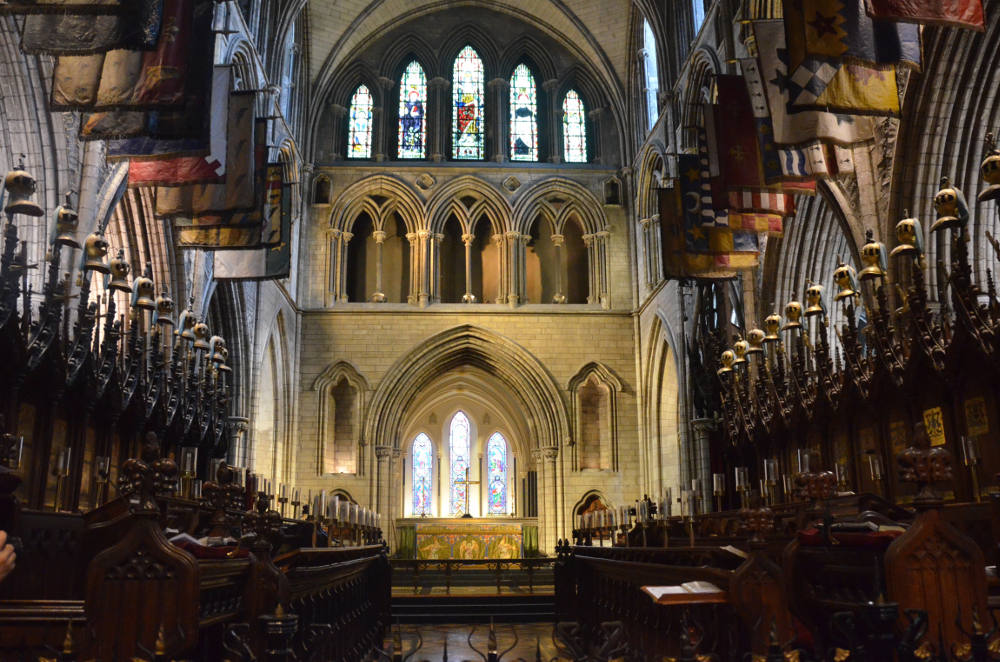
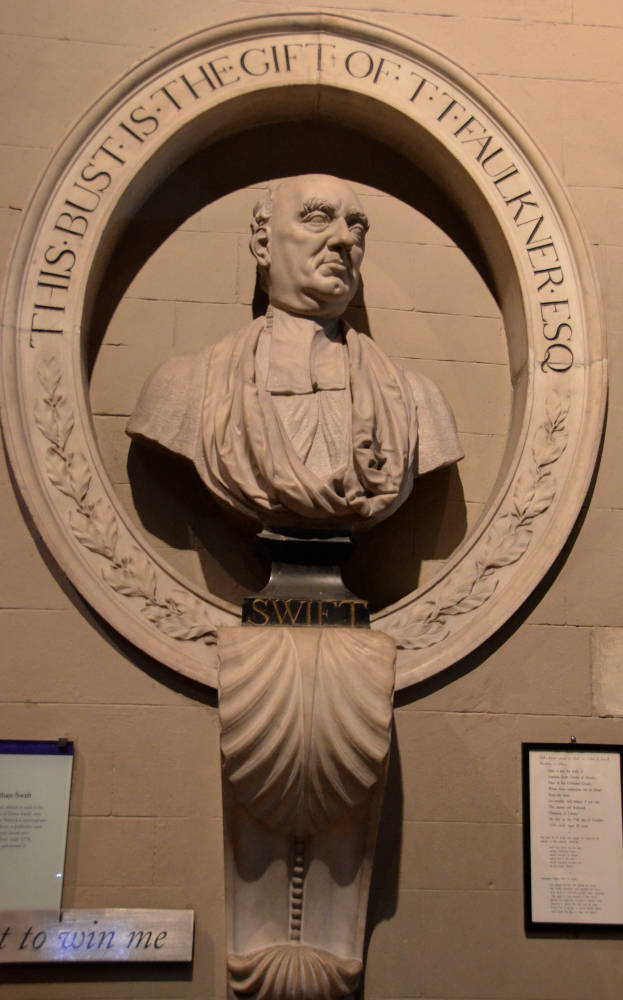
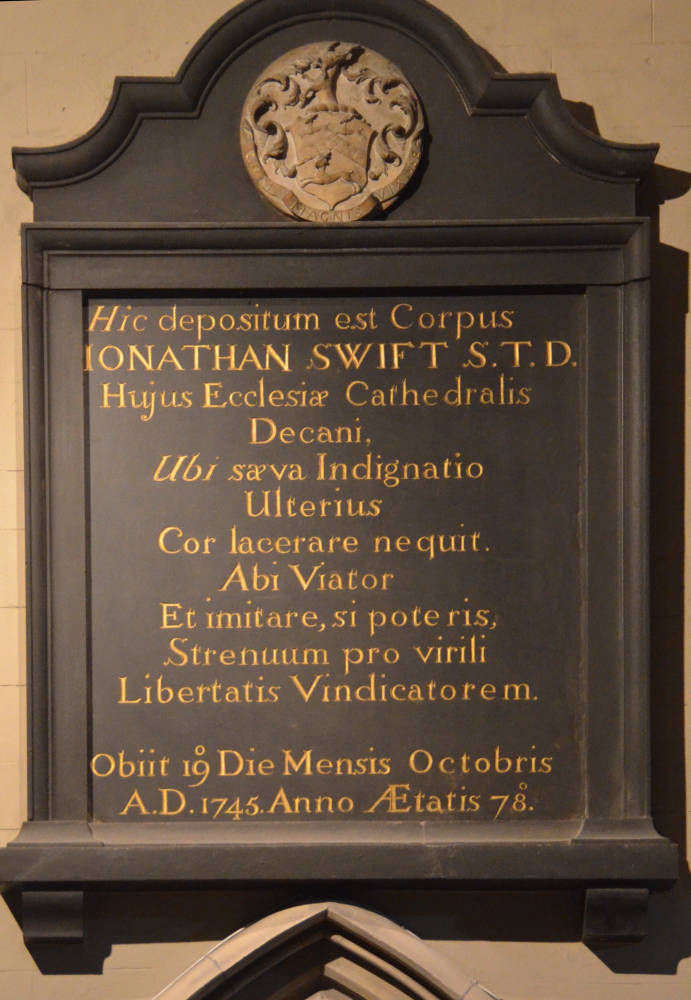
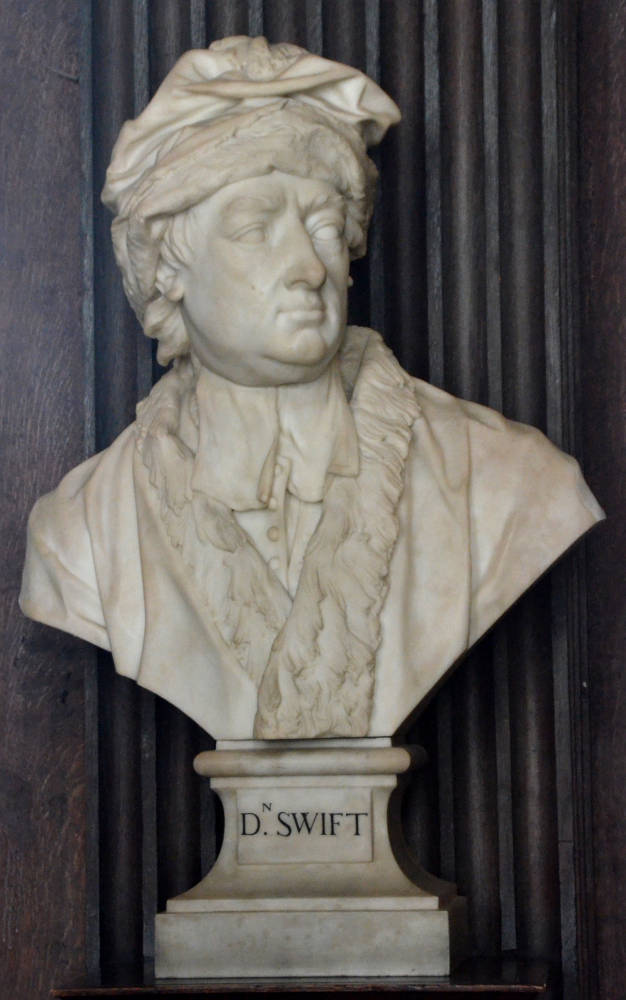
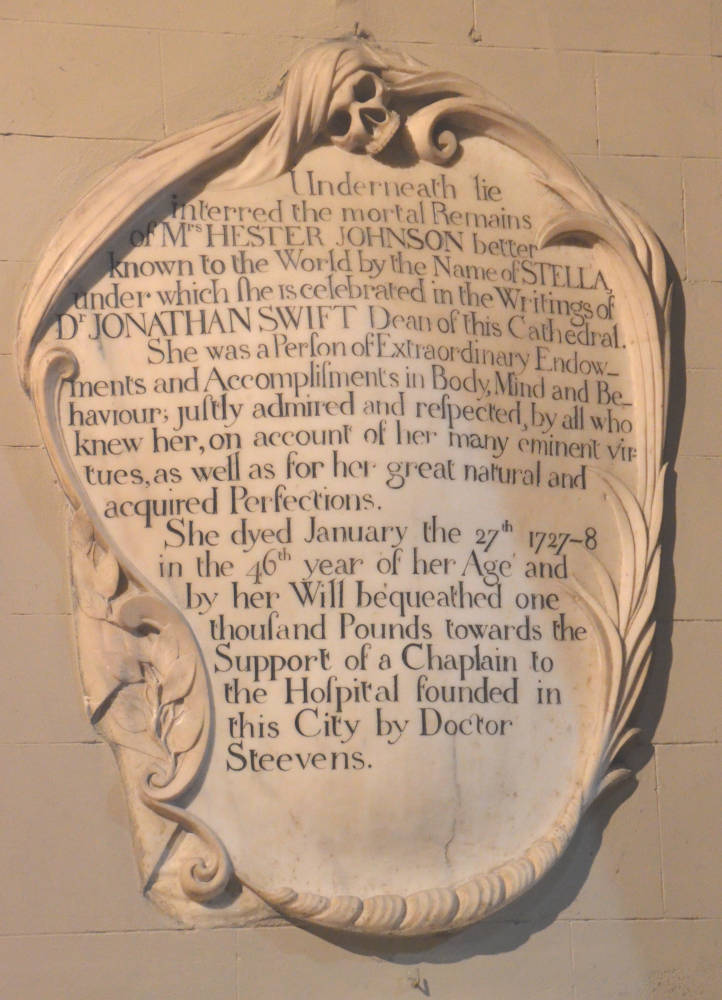
Image credits: George P. Landow, via The Victorian Web.
Sources and Further Reading
Primary and archival sources:
- Swift, Jonathan, and Thomas Sheridan. The Intelligencer, No. II, “The Inhospitable Temper of ’Squire Wether” (1728).
- The Schools’ Collection, Volume 0891, pp. 003–008, Guaire Christian Brothers’ School, Gorey, Co. Wexford. Dúchas © National Folklore Collection, UCD.
- “Dean Swift and the Ram of Gorey”, The Schools’ Collection, Volume 0823, p. 158, Reary, Rosenallis, Co. Laois. Dúchas © National Folklore Collection, UCD.
Biographical and historical sources:
- Dictionary of Irish Biography, “Ram, Sir Abel”.
- Trinity College Dublin, Trinity Writers: Jonathan Swift.
- St Patrick’s Cathedral, Dublin, Jonathan Swift, Dean 1713–1745.
- Wilson, T. G., “Swift’s Deafness; and His Last Illness”, Annals of Medical History, 1940.